


Treadmill Test (TMT): Purpose, Procedure, Indications, Interpretation, and Clinical Significance
Introduction
The Treadmill Test (TMT), also known as the Exercise Stress Test (EST) or Cardiac Stress Test, is a widely used non-invasive diagnostic test that evaluates how the heart responds to physical stress. It plays a crucial role in the early detection of coronary artery disease (CAD), assessment of exercise tolerance, and monitoring of cardiac therapy.
With the rising prevalence of cardiovascular diseases, diabetes, obesity, and sedentary lifestyles, the TMT has become an essential tool in preventive cardiology. This article provides a comprehensive, pharma-oriented overview of the Treadmill Test, covering its principle, indications, procedure, interpretation, advantages, limitations, and clinical relevance.
What Is a Treadmill Test (TMT)?
A Treadmill Test is a cardiac diagnostic procedure in which a patient walks on a treadmill while their heart rate, blood pressure, ECG, and symptoms are continuously monitored. The test gradually increases physical workload to assess how well the heart performs under stress.
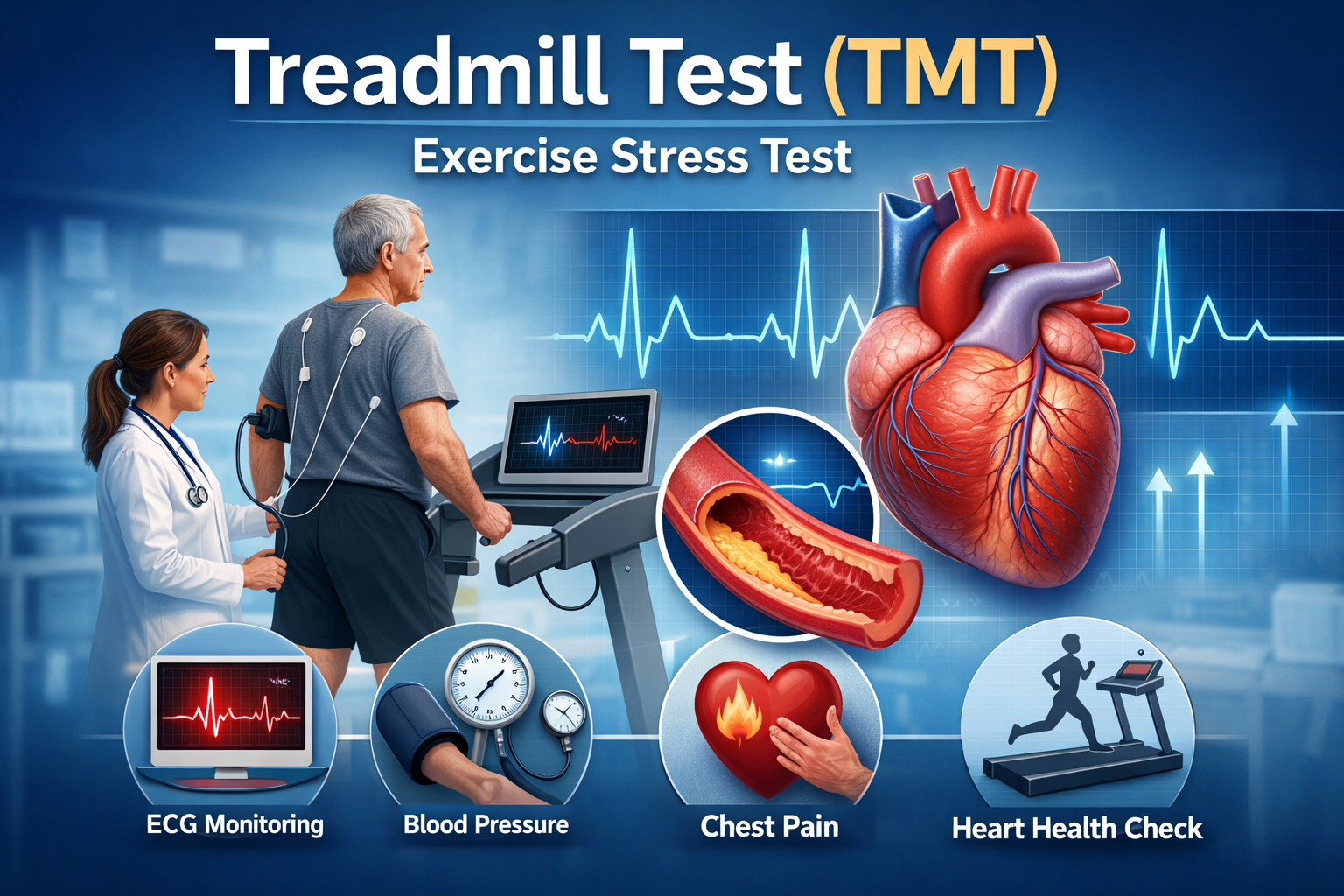
Unlike resting ECGs, which may appear normal, TMT helps unmask exercise-induced ischemia, arrhythmias, or abnormal blood pressure responses.
Principle of the Treadmill Test
The principle of TMT is based on the fact that:
- Physical exercise increases myocardial oxygen demand
- In patients with coronary artery narrowing, blood supply becomes insufficient during stress
- This leads to ECG changes, chest pain, or abnormal vital responses
The test follows standardized exercise protocols such as the Bruce Protocol, where speed and incline are increased every few minutes.
Indications of TMT
The Treadmill Test is commonly indicated for:
1. Diagnosis of Coronary Artery Disease (CAD)
- Evaluation of chest pain (angina)
- Detection of silent ischemia
2. Risk Stratification
- Assessing cardiovascular risk in asymptomatic individuals
- Pre-employment or fitness assessment
3. Post-Cardiac Event Evaluation
- After myocardial infarction
- Post-angioplasty or bypass surgery
4. Assessment of Treatment Efficacy
- Monitoring response to anti-anginal or antihypertensive therapy
5. Exercise Capacity Evaluation
- Athletes
- Patients with heart failure or valvular disease
Contraindications of TMT
TMT should not be performed in certain conditions:
Absolute Contraindications
- Acute myocardial infarction (within 48 hours)
- Unstable angina
- Severe aortic stenosis
- Acute myocarditis or pericarditis
- Uncontrolled arrhythmias
Relative Contraindications
- Severe hypertension
- Electrolyte imbalance
- Advanced heart block
- Physical inability to exercise
Pre-Test Preparation
Proper preparation ensures accurate results:
- Avoid heavy meals 2–3 hours before the test
- Wear comfortable clothing and footwear
- Avoid caffeine and smoking
- Certain medications (e.g., beta-blockers) may be stopped as advised
- Obtain informed consent
- Baseline ECG and vitals are recorded
TMT Procedure Step-by-Step
- Electrodes are attached to the chest for continuous ECG monitoring
- Baseline heart rate and blood pressure are measured
- Patient starts walking on the treadmill
- Speed and incline increase every 3 minutes
- ECG, BP, and symptoms are monitored continuously
- Test ends when:
- Target heart rate is achieved
- Patient develops symptoms
- Significant ECG changes occur
- Recovery phase monitoring is done for 5–10 minutes
Parameters Monitored During TMT
- Heart rate response
- Blood pressure response
- ECG changes (ST segment depression/elevation)
- Exercise duration
- Symptoms like chest pain, dizziness, breathlessness
Interpretation of TMT Results
1. Negative TMT
- No significant ECG changes
- Adequate exercise tolerance
- Low probability of CAD
2. Positive TMT
- ST-segment depression ≥1 mm
- Chest pain during exercise
- Abnormal BP response
- Indicates myocardial ischemia
3. Inconclusive TMT
- Inadequate heart rate achieved
- Baseline ECG abnormalities
- Requires further testing
Clinical Significance in Pharmaceutical Practice
From a pharmaceutical perspective, TMT helps in:
- Selecting appropriate anti-anginal therapy
- Adjusting beta-blockers, nitrates, calcium channel blockers
- Evaluating drug efficacy
- Guiding preventive therapy like statins and antiplatelets
- Patient counseling and lifestyle modification planning
Advantages of TMT
- Non-invasive and safe
- Cost-effective
- Widely available
- Provides functional cardiac assessment
- Useful for early disease detection
Limitations of TMT
- Lower sensitivity in women
- False positives and negatives
- Not suitable for physically disabled patients
- Less accurate in baseline ECG abnormalities
TMT vs Other Cardiac Tests
| Test | Key Feature |
|---|---|
| Resting ECG | Detects abnormalities at rest |
| TMT | Detects exercise-induced ischemia |
| Echocardiography | Structural assessment |
| Stress Echo | Combines stress with imaging |
| Coronary Angiography | Gold standard for CAD |
Role of Lifestyle and Risk Factor Control
A positive TMT emphasizes the need for:
- Smoking cessation
- Weight management
- Regular exercise
- Blood sugar and lipid control
- Medication adherence
Safety and Complications
TMT is generally safe when performed under supervision. Rare complications include:
- Arrhythmias
- Severe chest pain
- Hypotension
- Syncope
Emergency equipment and trained personnel are always available during the test.
Conclusion
The Treadmill Test (TMT) remains a cornerstone investigation in modern cardiology. It provides invaluable insights into cardiac function, exercise tolerance, and ischemic heart disease. For pharmaceutical professionals and healthcare providers, understanding TMT enhances clinical decision-making, improves patient counseling, and supports evidence-based therapy optimization.
With cardiovascular diseases on the rise, TMT continues to be a powerful, accessible, and preventive diagnostic tool.
For more regular updates you can visit our social media accounts,
Instagram: Follow us
Facebook: Follow us
WhatsApp: Join us
Telegram: Join us