


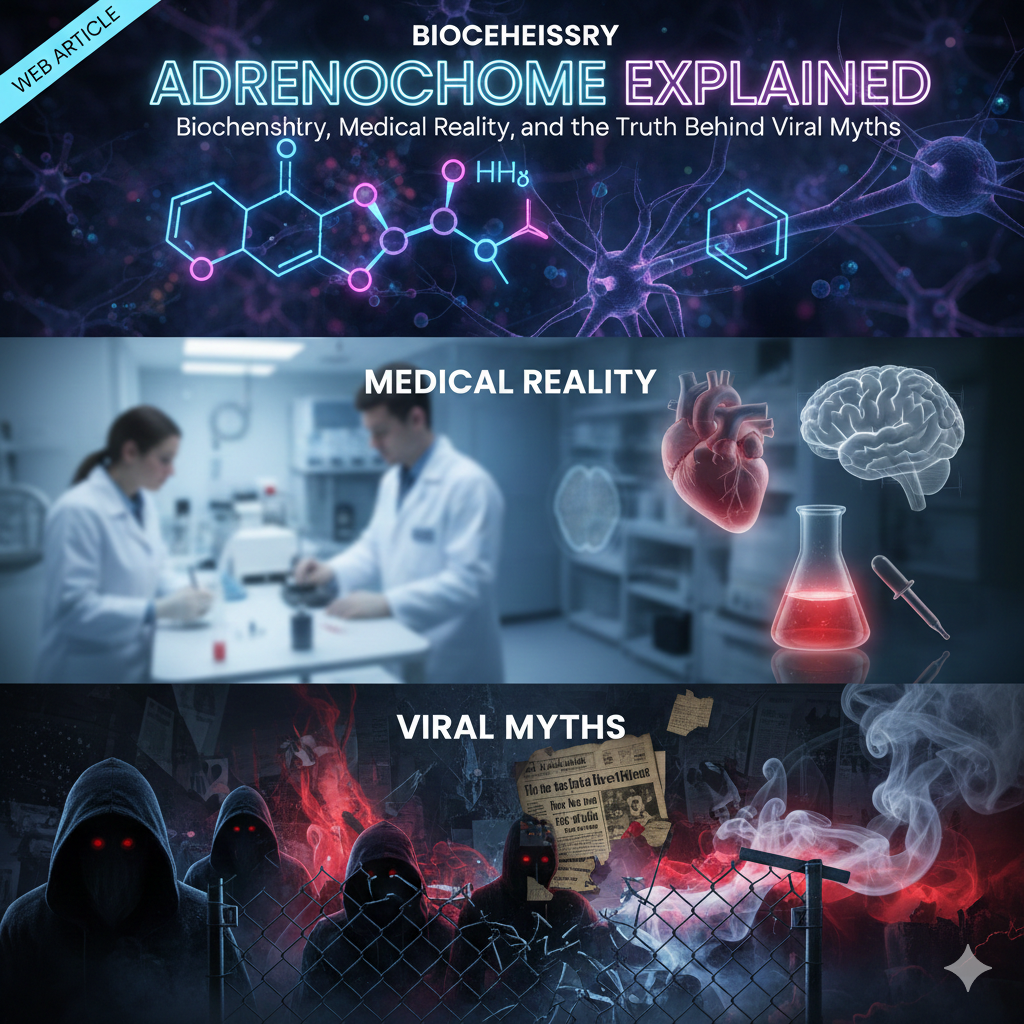
Adrenochrome Explained: Biochemistry, Medical Reality, and the Truth Behind Viral Myths
Introduction
In recent years, the term adrenochrome has surged across social media platforms, blogs, and video content—often framed as a mysterious substance linked to power, youth, secret elites, and even real-world criminal cases. What makes adrenochrome particularly dangerous as a topic of misinformation is that it is a real chemical compound, but its properties and relevance have been wildly distorted.
This article provides a clear, scientific, and evidence-based explanation of adrenochrome—what it is, how it forms, what medical science says about it, and why it has become central to modern conspiracy narratives. The goal is not to sensationalize, but to separate verifiable biochemical facts from fiction, and to restore clarity to a topic clouded by misinformation.
What Is Adrenochrome? (Scientific Definition)
Adrenochrome is a chemical compound formed by the oxidation of adrenaline (epinephrine), a hormone and neurotransmitter produced by the adrenal glands.
- Parent molecule: Adrenaline (epinephrine)
- Chemical class: Indole quinone
- Molecular formula: C₉H₉NO₃
- Formation mechanism: Oxidative conversion of adrenaline
In simple terms, adrenochrome is not a hormone, not a neurotransmitter, and not a drug. It is a by-product formed when adrenaline undergoes oxidation.
This reaction can occur:
- In laboratory conditions
- During chemical handling of adrenaline
- To a very limited extent during metabolic or oxidative processes
The Role of Adrenaline in the Human Body
To understand adrenochrome, it is essential to understand adrenaline itself.
Adrenaline is a critical hormone involved in:
- Fight-or-flight response
- Regulation of heart rate and blood pressure
- Bronchodilation
- Mobilization of glucose and fatty acids
Adrenaline is tightly regulated in the human body and is rapidly metabolized by enzymes such as:
- Monoamine oxidase (MAO)
- Catechol-O-methyltransferase (COMT)
Under normal physiological conditions, adrenaline is broken down efficiently, leaving little opportunity for adrenochrome formation.
How Adrenochrome Is Formed in the Body
Adrenochrome formation in vivo is minimal and incidental.
Key points:
- It is formed only through non-enzymatic oxidation
- The human body does not intentionally synthesize adrenochrome
- Produced amounts are extremely small and biologically insignificant
- It is rapidly degraded or cleared
There is no known physiological role for adrenochrome in humans.
Laboratory Synthesis vs Biological Reality
One of the most persistent myths is that adrenochrome must be “extracted” from humans. This is scientifically false.
Laboratory synthesis:
- Adrenochrome can be synthesized by oxidizing adrenaline using chemical oxidizing agents
- This process is:
- Simple
- Inexpensive
- Controlled
- Produces higher purity
Why human extraction makes no sense:
- Yield from biological sources would be microscopic
- Compound is chemically unstable
- Synthetic production is far superior in every way
From a chemistry and pharmacology standpoint, human harvesting would be irrational and unnecessary.
Early Medical and Psychiatric Research (1950s–1960s)
Adrenochrome gained limited scientific interest in the mid-20th century.
Why it was studied:
- Researchers hypothesized it might play a role in:
- Psychosis
- Schizophrenia
- Stress-related mental disorders
What happened:
- Studies failed to show consistent or causal effects
- Results were weak, contradictory, and non-reproducible
- The hypothesis was gradually abandoned
Current status:
- No modern psychiatric model includes adrenochrome
- It is not considered relevant to mental health disorders today
This abandoned research is often misrepresented online as “suppressed science,” which is inaccurate. It was discarded because it did not hold up to evidence.
Does Adrenochrome Have Any Medical Use Today?
Short answer: No
- No approved therapeutic indications
- No FDA, EMA, or CDSCO approval
- No clinical guidelines recommend its use
- No active pharmaceutical development
It is not prescribed, not marketed, and not clinically relevant.
Safety and Toxicology
Adrenochrome is not a safe or beneficial compound.
Potential concerns include:
- Pro-oxidant properties
- Cellular toxicity at higher concentrations
- Chemical instability
It is not suitable for human consumption, and there is no evidence of benefit.
Adrenochrome vs Viral Claims: A Fact-Check
| Viral Claim | Scientific Reality |
|---|---|
| It gives youth or immortality | ❌ No evidence |
| It is psychoactive | ❌ Not a recreational drug |
| It must be harvested from humans | ❌ Chemically false |
| It appears in Epstein files | ❌ No record |
| It is banned because it’s powerful | ❌ Simply irrelevant |
| Elites secretly use it | ❌ No proof |
| Fear increases potency | ❌ Biologically meaningless |
The Epstein Case: Separating Real Crimes from False Biology
The crimes associated with Jeffrey Epstein are real, documented, and horrific. They involve:
- Sex trafficking
- Abuse of minors
- Coercion and exploitation
- Complicity of powerful individuals
However:
- No Epstein court document mentions adrenochrome
- No victim testimony supports such claims
- No investigator or prosecutor has cited it
Linking adrenochrome to Epstein does not strengthen accountability—it weakens it by shifting focus from evidence-based criminal investigation to fictional biology.
Why Adrenochrome Became a Conspiracy Symbol
Several factors contributed to its rise in misinformation culture:
1. A real chemical with a dramatic name
“Adrenochrome” sounds technical and sinister.
2. Presence in fiction
It has appeared in novels and films, later misquoted as fact.
3. Abandoned research misrepresented
Old hypotheses are framed as “hidden truths.”
4. Internet amplification
Algorithms reward shocking content, not accurate content.
5. Emotional manipulation
Tying myths to real crimes increases virality.
Psychological Mechanics of the Myth
Conspiracy narratives often share patterns:
- Appeal to secret knowledge
- Create heroes vs villains
- Reject institutional trust
- Punish skepticism as “complicity”
Adrenochrome fits neatly into this framework, despite lacking evidence.
Why Scientific Literacy Matters
Misinformation about biomedical topics has real consequences:
- Erodes trust in medicine
- Distracts from real victims
- Undermines public understanding of science
- Fuels fear instead of accountability
Critical thinking is not cynicism—it is responsibility.
Frequently Asked Questions (FAQs)
Is adrenochrome illegal?
No. It is not scheduled or banned—it is simply unused.
Is adrenochrome naturally present in the body?
Only in trace, insignificant amounts.
Can adrenochrome be purchased?
Not as a drug or supplement. Any claims otherwise are misleading.
Does stress increase adrenochrome levels?
No meaningful evidence supports this.
Why do people believe these claims?
Because misinformation spreads faster than correction, especially when linked to real trauma.
Conclusion
Adrenochrome is a real chemical compound—but it is biologically unremarkable and medically irrelevant. The myths surrounding it are not rooted in pharmacology, medicine, or evidence, but in fiction, misinterpretation, and internet amplification.
Understanding the difference between verified science and viral narratives is essential—not only for public health, but for justice, truth, and accountability.
The real dangers are not hidden molecules—but misinformation itself.
Citations & References
Primary Biochemistry & Pharmacology References
- Goodman & Gilman’s The Pharmacological Basis of Therapeutics
Brunton LL, Hilal-Dandan R, Knollmann BC.
McGraw-Hill Education.
(For adrenaline metabolism, oxidative pathways, and lack of clinical relevance of adrenochrome) - Rang & Dale’s Pharmacology
Rang HP, Ritter JM, Flower RJ, Henderson G.
Elsevier.
(For catecholamine metabolism and oxidative degradation) - Katzung & Trevor’s Basic and Clinical Pharmacology
Katzung BG, Vanderah TW.
McGraw-Hill.
(For epinephrine pharmacokinetics and metabolic fate)
Original Scientific Research & Reviews
- Heacock RA, Forrest TP.
The chemistry of adrenochrome and related compounds.
Chemical Reviews, 1958.
(Classic chemical characterization of adrenochrome) - Smythies JR.
The adrenochrome hypothesis of schizophrenia.
International Review of Neurobiology, 1967.
(Historical psychiatric hypothesis later abandoned) - Hoffer A, Osmond H.
Adrenochrome and the biochemistry of schizophrenia.
Journal of Mental Science, 1954.
(Early hypothesis, not supported by later evidence) - Harris LS et al.
Failure to demonstrate psychotomimetic effects of adrenochrome.
Archives of General Psychiatry, 1964.
(Negative findings leading to abandonment of the theory)
For more regular updates you can visit our social media accounts,
Instagram: Follow us
Facebook: Follow us
WhatsApp: Join us
Telegram: Join us